


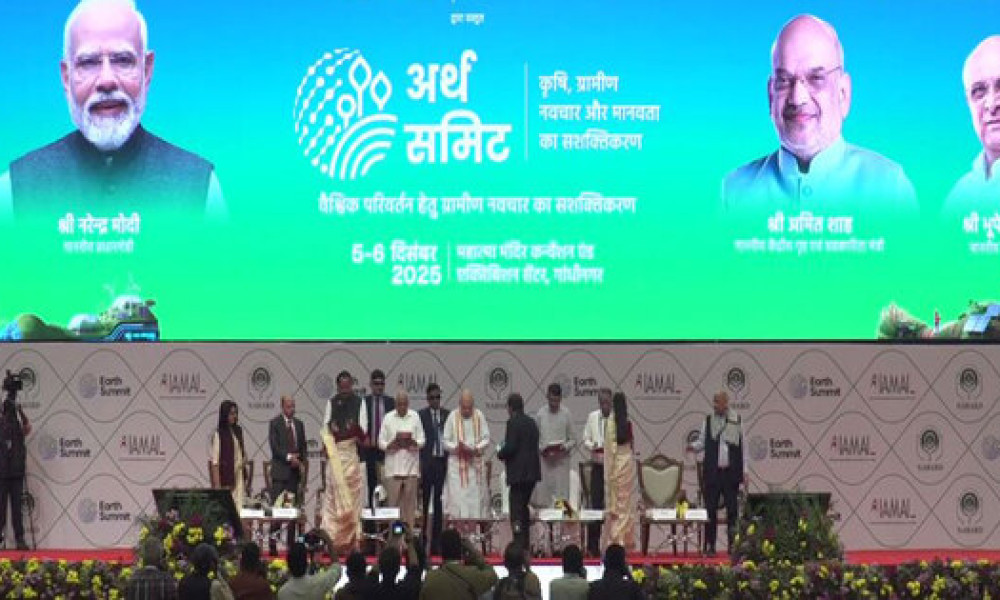
Union Home Minister Amit Shah and Gujarat Chief Minister Bhupendra Patel inaugurated the two-day Earth Summit 2025-26 at Mahatma Mandir in Gandhinagar. The summit is a collaborative effort by NABARD and the Internet and Mobile Association of India. Both leaders toured various exhibition stalls at the event.
The inauguration was graced by prominent figures including Gujarat Legislative Assembly Speaker Shankar Chaudhary. State Agriculture Minister Jitu Vaghani and Deputy Speaker Jethabhai Ahir were also present. Their attendance underscored the event’s significance for regional policy.
Minister Shah outlined the summit’s broader vision. He stated that a series of three Earth Summits aims to position the rural economy as the largest contributor to India’s GDP. This edition in Gujarat is the second in that crucial series.
He reflected on Mahatma Gandhi’s enduring vision. Gandhi emphasized that India’s development is inseparable from the progress of its villages. For decades after independence, key rural pillars like agriculture and cooperatives were neglected.
Prime Minister Narendra Modi’s tenure since 2014 marked a shift. The government prioritized agriculture, animal husbandry, and the cooperative sector. This focus revived Gandhi’s vision for rural-led national growth.
Substantial financial commitment backs this priority. Shah revealed the combined budget for relevant ministries has tripled since 2014. It has surged from Rs. 1.02 lakh crore to over Rs. 3.15 lakh crore for 2025-26.
The goal is a developed India, or Viksit Bharat. This vision hinges on the welfare of every citizen. Empowering the rural economy is central to achieving this national aspiration.
Ambitious plans for the cooperative sector are underway. The government aims to establish one cooperative institution in every panchayat. The target is to create over 50 crore members and triple the sector’s GDP contribution.
The summit’s theme is ‘Empowering Rural Innovation for Global Change’. Discussions will focus on how small rural innovations can boost the national economy. The aim is to find practical solutions to existing challenges.
Shah expressed strong confidence in the summit’s outcomes. He believes the deliberations will provide answers to major issues facing the rural economy. The third and final summit is scheduled for Delhi next year.
The event has already achieved significant scale. It has convened over 10,000 delegates, 1,200 corporates, and 500 expert speakers. More than 300 startups and 250 exhibitors have also participated.
Technology is a non-negotiable for cooperative advancement. Shah acknowledged that small societies cannot afford costly software development. NABARD’s ‘Sahakar Sarathi’ initiative offers a digital solution.
This initiative includes over 13 digital service portals. They will unify cooperative banks on a single, modern platform. The technology will support essential functions like KYC and legal documentation.
The ‘Sahakar Sarathi’ app is a key tool. Developed under the Cooperative Banking Act, it will ensure compliance with RBI regulations. It will also offer enhanced facilities for credit card holders in the future.
A successful pilot project was conducted in Gujarat’s Banaskantha and Panchmahal districts. It involved operating cooperative institutions’ accounts directly within cooperative banks. The model generated thousands of crores in low-cost deposits.
Policy insights from this experiment will guide a national rollout. Necessary improvements will be made based on the successful model. This approach aims to strengthen cooperative banking across India.
Natural farming is gaining steady momentum in India. Currently, 49 lakh farmers have adopted these practices. To ensure product credibility, a comprehensive laboratory chain is being established.
This chain, in partnership with India Organics and Amul Organics, will allow testing to international standards. Farmers can then export their products globally. Amul Organics has already made 40 food products available online.
India’s share in the global organic food market is projected to grow dramatically. It is expected to surpass 20% by 2030. By 2035, it could exceed an impressive 40%.
The cooperative sector is diversifying into new ventures. A cooperative taxi service is expected to become the country’s largest within two years. A trial in Delhi has already registered 51,000 drivers.
Cooperative insurance is another upcoming initiative. It will create employment opportunities for youth in every village. These expansions showcase the sector’s dynamic evolution.
Gujarat Chief Minister Bhupendra Patel addressed the gathering. He called the summit’s timing in Gandhinagar perfectly appropriate. The event focuses on empowering agriculture, rural sectors, and innovation.
Patel highlighted Gujarat’s pioneering role in cooperative development. He credited Union Minister Amit Shah’s leadership for accelerating the rural economy. The state has championed financial inclusion and green growth.
Initiatives in natural farming, animal husbandry, and women’s participation were detailed. Patel outlined the path of cooperative-driven prosperity charted by Gujarat. This model serves as an inspiration for the national agenda.
The summit also featured key launches and releases. Minister Shah inaugurated the ‘Sahakar Sarathi’ digital initiative. He released the ‘State Focus Paper of Gujarat 2026-27’ and a NABARD-BCG research paper.
NABARD Chairman Shaji K.V. welcomed attendees at the event’s start. He presented a comprehensive overview of the summit’s objectives and scheduled sessions. His address set the stage for two days of focused discussion.
The audience included a wide array of stakeholders. Chairman of Gujarat State Cooperative Bank Ajay Patel and Union Cooperation Secretary Dr. Ashish Kumar Bhutani were present. Senior officials, bankers, entrepreneurs, and many farmers also attended.