


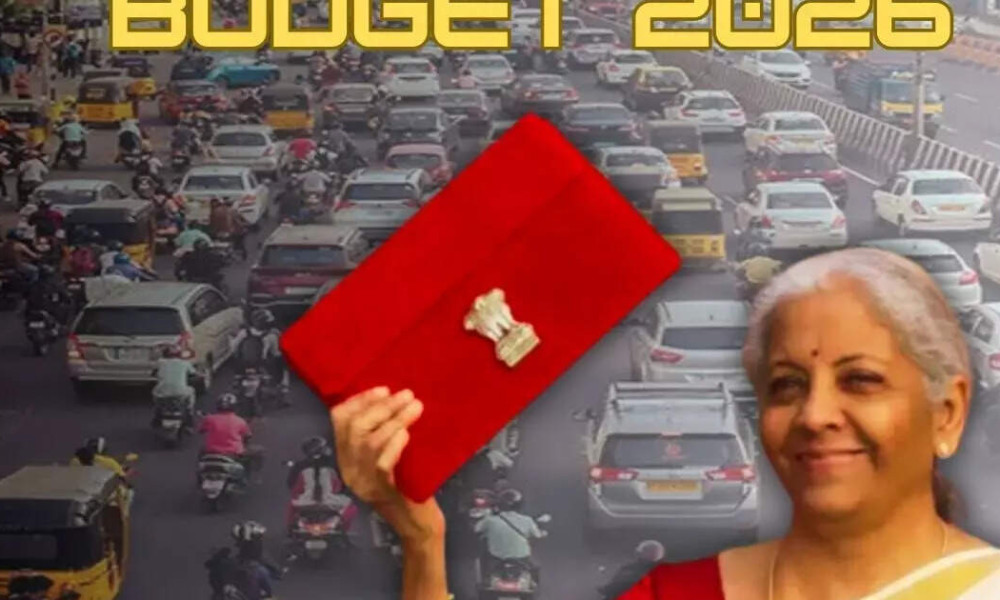
For India’s automobile industry, the turbulence of the past few years appeared to ease after September 2025. A long-awaited GST reset corrected long-standing tax distortions, and festive-season demand brought buyers back into showrooms. Year-end sales helped manufacturers close the calendar year on a steadier note.
This relief mattered for a sector that contributes close to 7 percent of India’s GDP and anchors a large part of the manufacturing base.
But did the rebound go far enough?
The new calendar year has turned attention to the next major policy moment. Union Budget 2026-27, set to be tabled on February 1, is being watched closely by an industry that has already absorbed a major tax overhaul.
The question is no longer about structural fixes alone. Auto experts say it is about whether targeted measures can steady demand, ease cost pressures, and restore confidence across segments.
Industry data shows why the mood is cautious. SIAM and FADA numbers indicate that while overall volumes improved from post-pandemic lows, the recovery remained uneven.
Premium passenger vehicles continued to find buyers, but entry-level cars and two-wheelers struggled. However, rural passenger vehicle growth has been robust, highlighting an uneven recovery.
Original equipment manufacturers have steadily added safety features and compliance upgrades even to base variants. This shift has pushed up vehicle prices, adding pressure on household budgets.
The affordability debate matters because India’s vehicle penetration remains strikingly low. Only 26 out of every 1,000 people owned a car in fiscal year 2024-25.
Experts say this gap represents long-term opportunity, but only if mass-market demand is revived. Budget-linked measures that lower upfront costs and ease financing could help restore balance in entry-level segments.
Saurabh Agarwal of EY India emphasized the need for demand sustainability and cost containment to empower the rural population. He suggested extending the PM E-Drive scheme and introducing interest subvention schemes.
Waman Parkhi of KPMG in India called for clear policy support for strong hybrids by extending concessional GST rates or customs duty benefits. Rationalising duties on key components would help OEMs manage costs.
Electric vehicles were expected to cushion some of the slowdown. Retail trends suggest growth has moderated in certain EV segments, particularly among two-wheelers.
Tushar Choudhary of Motovolt Mobility said Budget 2026 presents a critical opportunity to accelerate EV adoption. A multi-pronged approach can boost consumer and sectoral confidence.
Sheena Sareen of Deloitte India suggested additional demand-side incentives and reducing import duty on key components like batteries. She also recommended lowering GST rates on charging services.
She highlighted the need for targeted interventions for mass-market vehicles. Streamlining approval processes and ensuring time-bound disbursal of incentives under a new PLI scheme are recommended.
Vehicle scrappage has yet to reach its potential. Sareen noted that current prescribed rebate rates can be revised upward to pass on additional benefits to end-customers.
Parkhi suggested providing a GST-linked scrappage incentive, claimable against the purchase of a new vehicle. Ensuring such an incentive is refundable would create a clear benefit.
India produced more than 31 million vehicles in FY25, with exports rising 19 percent. Yet several EV, hybrid, and battery-related projects have slowed as companies reassess costs.
Sareen said the existing PLI scheme for Advanced Chemistry Cell manufacturing has a limited number of successful bidders. Relaxations in eligibility criteria can be introduced by launching a newer version of the scheme.
She also linked this to critical minerals, stating implementation of the National Critical Mineral Mission should be closely monitored.
Tier-II and Tier-III suppliers face rising compliance costs and working capital pressure. Sareen said introducing a simplified and harmonised customs structure will enhance ease of doing business.
Parkhi added that reducing customs duties on essential inputs and allocating funds for auto component clusters would support suppliers.
Preparation for stricter CAFE Phase III norms also demands attention. Agarwal said the upcoming CAFE norms set ambitious fleet-wide CO2 emission targets, requiring in-depth consultation with industry.
Sareen added that Budget 2026 should ensure CAFE compliance is fiscally facilitative rather than punitive. This can be achieved through GST credits or accelerated depreciation on relevant investments.