


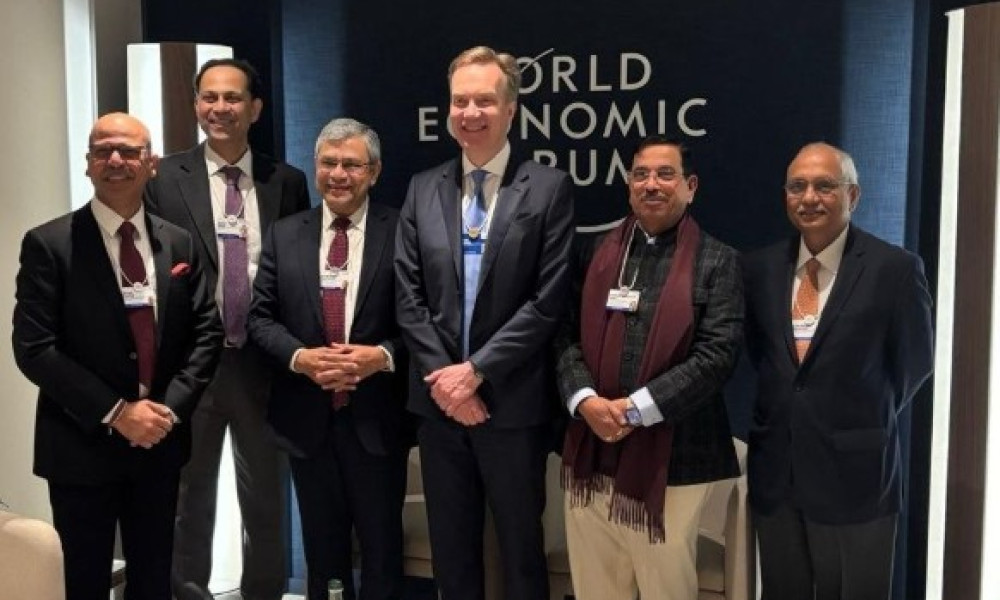
Union Minister Pralhad Joshi showcased India’s leadership at the World Economic Forum in Davos. His engagements highlighted a just and inclusive global energy transition. The discussions underscored India’s pivotal role on the world stage.
Joshi held talks with World Economic Forum President Borge Brende and Minister Ashwini Vaishnaw. They focused on global cooperation for shared economic challenges. Multilateral platforms like the WEF are crucial for building consensus.
A roundtable discussion featured leaders from Maharashtra and Zimbabwe. Joshi shared India’s experience in scaling renewable energy solutions. This knowledge is particularly relevant for the Global South.
Guided by Prime Minister Narendra Modi’s vision, India’s clean energy transition proves growth and sustainability can coexist. Flagship initiatives like PM Surya Ghar Muft Bijli Yojana are expanding access. The PM-KUSUM scheme is empowering farmers with solar power.
These programs are reducing costs for households and agricultural sectors. They demonstrate a practical model for affordable clean energy. India’s approach is both scalable and impactful.
Decentralised renewable energy systems and mini-grids play a key role. They improve reliability in remote and weak-grid regions. This enhances resilience across the energy network.
Joshi reaffirmed India’s commitment to inclusive energy transitions. The nation will continue sharing solutions through the International Solar Alliance. South-South cooperation is vital for a climate-secure future.
Addressing a session on de-risking the green leap, Joshi placed India in the global spotlight. He spoke alongside Madhya Pradesh Chief Minister Mohan Yadav. India is driving the global renewable energy transition.
This transition is advanced through strong, reform-oriented states. They translate national policy into tangible outcomes. Subnational action is a critical component of success.
The key global challenge is not ambition or capital, but execution. India’s state-led success stories offer valuable lessons. Effective implementation is the true test.
On the sidelines, Joshi met with Mercuria Group’s CFO Guillaume Vermersch. Discussions focused on advancing collaboration for India’s clean energy priorities. Topics included scaling renewables and strengthening carbon markets.
The talks also covered green hydrogen, biofuels, and energy storage. Mercuria Group committed to investing nearly fifty percent in green energy. They expressed strong interest in India’s expanding ecosystem.
Joshi emphasized India’s scale and speed of execution. Solar tariffs have declined by nearly eighty percent. Renewable energy with storage is now cost-competitive.
Green hydrogen and ammonia prices from India are among the world’s most competitive. Domestic renewable manufacturing capacity has expanded to 144 GW. These metrics showcase remarkable progress.
Joshi delivered a keynote on AI for energy. He highlighted India’s energy transition journey for the global community. The focus was again on relevance for the Global South.
He outlined AI’s transformative potential in the energy sector. Artificial intelligence can improve forecasting and reduce losses. It also lowers costs and strengthens grid reliability.