


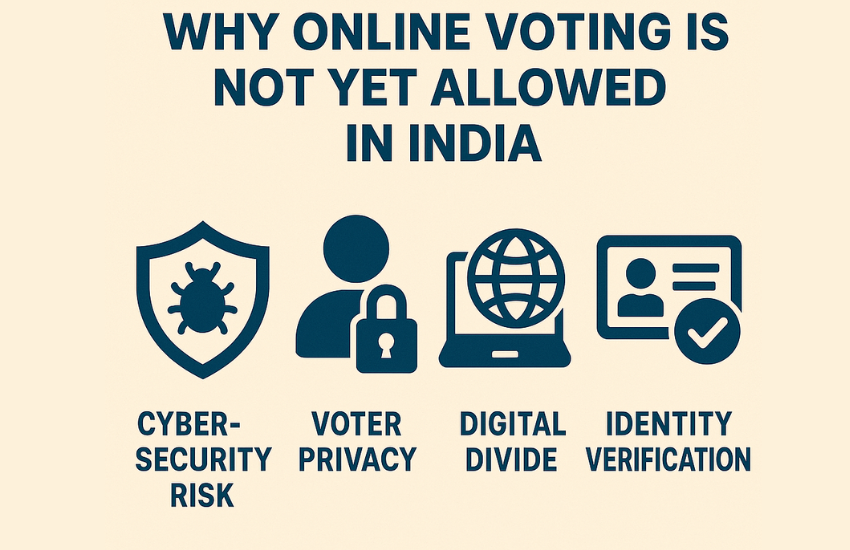
Online voting is not yet allowed for Lok Sabha or Vidhan Sabha elections mainly due to concerns about security, privacy, and accessibility. Online systems can be vulnerable to hacking and cyberattacks, which could compromise the integrity of election results. Ensuring voter privacy is also difficult in digital environments, where votes must remain completely secret. Additionally, India still faces a digital divide, as many citizens do not have reliable internet access or digital literacy. Verifying voter identity online in a foolproof way is another major challenge. Because of these reasons, the Election Commission continues to rely on EVMs, which are considered more secure and reliable at scale.
India’s main elections use EVMs (Electronic Voting Machines), and moving to online voting faces these major concerns:
| Concern | Explanation |
|---|---|
| Cybersecurity risk | Online systems can be hacked, manipulated, or attacked. |
| Voter privacy | Votes must remain secret — very hard to guarantee online. |
| Digital divide | Millions still lack secure internet access. |
| Identity verification | Ensuring one person = one vote, without impersonation. |
Do Any Countries Do Fully Online Voting?
A few small countries like Estonia allow nationwide online voting.
But they have very strong digital identity frameworks and smaller populations.
🇮🇳 What India Is Working On Now
The ECI (Election Commission of India) is developing:
| Upcoming Feature | Status |
|---|---|
| Remote Voting System for Migrant Workers | Prototype tested. Would allow an eligible voter to vote from another city, but still via a controlled polling booth, not from mobile phones. |
| Aadhaar-based voter authentication | Under discussion but facing privacy debates. |