


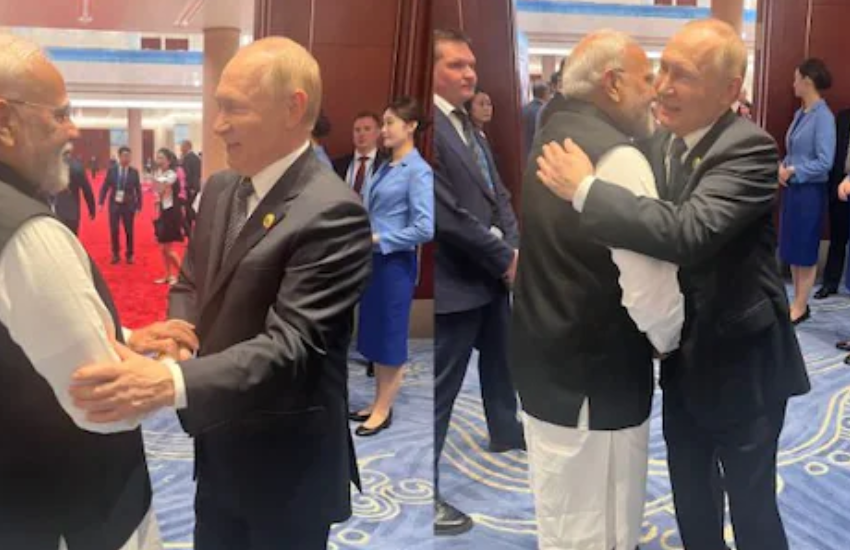
Amidst a landscape of complex international relations, Indian Prime Minister Narendra Modi and Russian President Vladimir Putin recently engaged in a significant bilateral meeting. This interaction took place on the sidelines of the Shanghai Cooperation Organisation (SCO) summit, a gathering hosted by China that brings together key Eurasian leaders. The exchange was notably warm, with Prime Minister Modi himself sharing images on X (formerly Twitter) depicting a cordial embrace and handshake. His caption, “Always a delight to meet President Putin!” underscored the enduring nature of their relationship. This meeting comes at a critical juncture for India, as it navigates the ongoing geopolitical currents, including the Ukraine conflict and increasing pressure from the United States regarding its economic ties with Russia.
The SCO summit provided a crucial platform for these two leaders to discuss a range of issues vital to both nations. Their agenda included focused conversations on bilateral trade, energy cooperation, and defense collaboration. From New Delhi’s perspective, this interaction served to reaffirm India’s unwavering commitment to its “special and privileged strategic partnership” with Russia. This partnership is deeply rooted in history, tracing back to the Cold War era when the Soviet Union emerged as a steadfast ally during India’s non-aligned foreign policy stance. Over many decades, this bond has matured into a multifaceted alliance, encompassing not just defense but also vital energy sectors and collaboration within multilateral forums such as BRICS and the SCO.
Indeed, the economic dimension of this partnership has seen remarkable growth in recent years. Bilateral trade between India and Russia has surged, reaching an unprecedented $68.7 billion in the fiscal year 2024-25. This figure represents a nearly six-fold increase compared to pre-pandemic levels. Such significant expansion has elevated Russia to India’s fourth-largest trading partner, a testament to the robust economic ties forged between the two nations. The ambition is even grander, with both countries setting a target of achieving $100 billion in trade by 2030. A primary driver of this impressive growth has been India’s imports of discounted Russian crude oil. These imports have seen a dramatic increase since Western sanctions, imposed after Russia’s 2022 invasion of Ukraine, redirected Moscow’s energy exports eastward.
In 2024 alone, Russia accounted for approximately 40% of India’s total crude oil imports. This amounted to roughly 1.8 million barrels per day, valued at over $52 billion. These substantial purchases have played a pivotal role in bolstering India’s energy security, a critical factor for its rapidly expanding economy. Furthermore, industry analyses suggest that these imports have resulted in an estimated $13 billion in savings for India in import costs over the past two fiscal years. Indian officials have consistently maintained that these imports are in full compliance with international norms, particularly highlighting that they fall below the G7’s $60-per-barrel price cap. They also argue that these purchases have served to prevent a more drastic spike in global oil prices, benefiting the international market.
However, this growing reliance on Russian oil has not gone unnoticed by the United States. Recently, President Donald Trump imposed a 25% tariff on Indian exports to the U.S. He cited India’s oil purchases as indirectly providing funding for Russia’s war efforts in Ukraine. The Trump administration has even escalated its rhetoric, suggesting the possibility of further penalties unless India significantly curtails its imports from Russia. From India’s viewpoint, such measures appear to disregard a certain degree of hypocrisy. They point out that the European Union and the U.S. themselves continue to engage in billions of dollars worth of trade with Russia. India, on the other hand, emphasizes that its imports are primarily driven by pressing national energy needs, rather than any geopolitical favoritism. India has consistently asserted its strategic autonomy, steadfastly refusing to join Western sanctions against Russia. Instead, it has actively advocated for dialogue as the most effective means to resolve the Ukraine crisis.
As India continues its trajectory towards becoming a $5 trillion economy, its partnership with Russia presents numerous opportunities. These span critical sectors such as energy, advanced technology, and access to Arctic resources. Looking ahead, there are joint ventures anticipated in areas like nuclear energy and pharmaceuticals. Moreover, enhanced connectivity is on the horizon through initiatives such as the International North-South Transport Corridor. The recent meeting between Prime Minister Modi and President Putin underscores the intricate balance India maintains in its foreign policy. This balance allows it to pursue its national interests while navigating a complex global stage. The partnership holds significant weight, continuing to evolve and adapt to new challenges and opportunities alike. India remains committed to its strategic choices, shaping its future with autonomy and a clear vision. This ongoing relationship is a testament to the enduring ties between the two nations, providing stability and potential for growth in an ever-changing world.